Azure Kubernetes Service

Accelerate your cloud native journey with Azure Kubernetes Service
When companies decide to modernize their applications, they often consider container-based solutions to increase their efficiency, agility and scalability. That’s where AKS, or Azure Kubernetes Service, comes in: a managed Kubernetes solution from Microsoft Azure. Let's dive into what AKS is, share our perspective on it, and show you in which cases it can be the solution that your business needs.
- Get to know the basics of Azure Kubernetes Service (AKS).
- Compare AKS with a self-managed Kubernetes setup.
- Discover why a managed service pays off for your microservices.
What is Azure Kubernetes Service (AKS)?
Azure Kubernetes Service is a managed service that allows you to deploy, scale and manage containerized applications on Azure. For your business, this means that you won’t have to worry about the underlying control plane infrastructure.
To get a bit more technical, everything you see in the image on the left is being managed by AKS. Good to know: Azure doesn’t charge any costs for the infrastructure that the Kubernetes control plane uses. In other words, they manage it all without demanding you pay high sums of money. Win-win, indeed! Of course, the service is not completely free: you still pay for the compute power used by your actual containers.
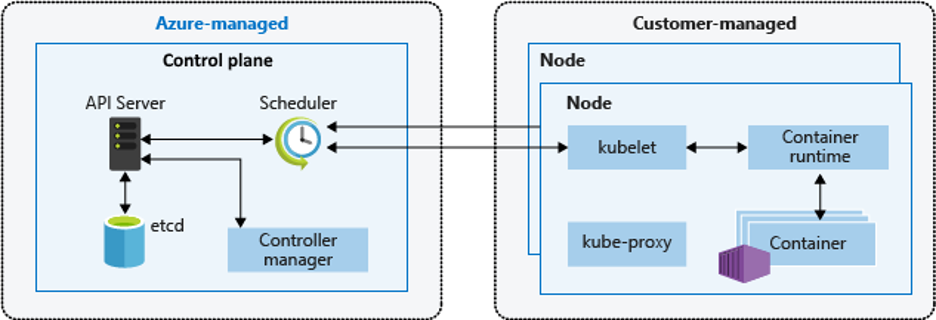
Microsoft documentation image outlining the AKS management distribution
AKS makes it easy to run and manage workloads in Azure's cloud services as well, and it also provides integrated support for Azure resources such as, but not limited to Azure Monitor, Azure Active Directory, Azure Networking, Azure Key Vault and Azure Storage. That’s what makes it a perfect solution for businesses who want to modernize their applications to a cloud-native, containerized architecture.
If you want to dive deeper into which scenarios AKS is most suited for, be sure to check out our other AKS blog.
AKS vs a self-managed solution: which one?
Self-managed Kubernetes solutions require users to manually take care of the underlying Kubernetes control plane. AKS simplifies the process by providing a managed service that takes care of the underlying infrastructure for you, so you can focus on your (containerized) applications.
AKS is therefore ideal for organisations who are looking to run large amounts of microservices or multiple application containers. Sure, it requires more configuration compared to serverless options like Azure Container Apps or Azure Container Instances. However, it offers you more flexibility at the same time. Ultimately, AKS can be a great solution, but it's important to weigh the pros and cons before deciding.
Are there other Azure container platforms?
Yes! As we mentioned in the paragraph above, Azure also provides Azure Container Apps (ACA), Azure Container Instances (ACI) as well as Web Apps for Containers.
The first, ACA, is a fully managed service that allows you to, what’s in a name, use and manage containerized applications in Azure. It is a developer-friendly solution, meaning developers spend less time on infrastructure to efficiently scale their applications. That being said, even though ACA runs on top of AKS, ACA does not provide access to the underlying Kubernetes infrastructure.
Like ACA, ACI presents a similarly simple Azure service to deploy container-based applications without having to manage the underlying infrastructure. The difference between the two can seem complex. Basically, you should consider ACI to be a lower-level building block compared to ACA. In Microsoft's own words:
"Concepts like scale, load balancing, and certificates are not provided with ACI containers. For example, to scale to five container instances, you create five distinct container instances. Azure Container Apps provide many application-specific concepts on top of containers, including certificates, revisions, scale, and environments."
Finally, Web Apps for Containers is a more specific solution from Azure when it comes to deploying containerized web applications. Compared to the other container-native solutions we've discussed so far, this is built specifically to provide hosting support for containerized web applications.
As more and more applications are evolving in this direction, the container-native solutions are becoming more popular, even if there are still some technical use cases to vouch for, where Web Apps for Containers is the best way to go.
Have we sparked an interest to know more about the subject? We’re creating a series on AKS to provide you with more concrete use cases and best practices. Our next installment on when (not) to use AKS is already online, check it out here!
Ready to go cloud-native with Azure Kubernetes Service?
We guide your team from first deployment to production-grade Kubernetes on Azure.

Want more? Read on!

AKS Policies: why are they the essential guardrail for your cluster?
Azure Kubernetes Service (AKS) gives you tremendous flexibility to build and scale applications. However, anyone with access can deploy, which opens the door to unnecessary risks. Luckily, there’s a way to regain control and secure your cluster: policies. We’ll show you how they work.

VVSG hosts scalable Drupal platform on AKS
VVSG needed a modern, scalable, and high-performance hosting solution for their core Drupal application, one that they could own and manage within their own Azure tenant. Want to know how we built it for them on AKS?